





Eye For Film >> Movies >> One Battle After Another (2025) Film Review


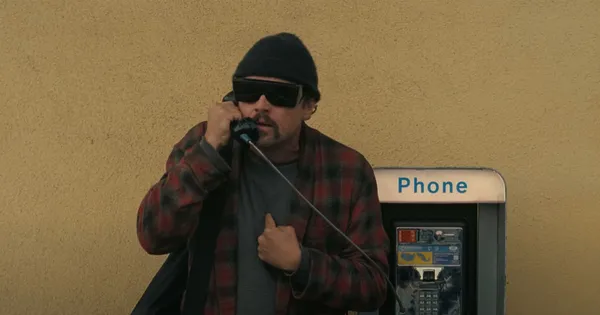

Loosely based on Thomas Pynchon's 1990 novel Vineland, One Battle After Another subjects a somewhat useless not-quite-everyman to a variety of vicissitudes. There are shades of other bathrobe wearing protagonists like The Dude and The Master and what shades they are, shoplifted and brutalist in their outlook. 'Loose' doesn't begin to describe how woolly the relationship between Pynchon's source text and Paul Thomas Anderson's film are. They are of a kind. The names and locations and dates and overarching overreach of state apparatus have been changed along with the innocent.
Not to protect them. To be clear, protection is something one has to achieve for oneself. That could be one of the mottoes of The French 75, a revolutionary cadre named after a cocktail. No champagne socialists these. They're ginned up, past the sugar in the gas tanks stage. When life gives you lemons, make armed interventions. Perfidia Beverley Hills (Teyana Taylor, magnetic) draws others into her orbit. That name is part of the flavour of Pynchon that's replicated in feel if not specific, in the 'source' novel.
One can't cross the same river twice, and to that extent it's hard to argue that it's the same one at the mouth as the source. There she's Frenesi Margaret, mother of Prairie, away from Zoyd Wheeler. Here he's Bob, father of Willa. Leonardo DiCaprio has form for the caper, the antic; one might catch him if one could and this has the semi-mythic and epic length of other Hollywood fairy tales. What he slips in the pocket in the book is a business card. Here it's a breadboard circuited crumb, a handset for Gretel. Who carries it is different too, and why. Chase Infiniti makes a firecracker big screen début. I am confident that she will make further, equally kinetic, impacts in future.
The book is rooted in Reagan's California, the War on Drugs, but those are both places of the past. It's maybe Schwarzenegger's California now. As the Dead Kennedys might note it was Jerry Brown's twice but it's not his mansion that's used for an exterior location. As for the War on Drugs, drugs won. Sicario: Day Of The Soldado conflated exterior threats to the point of forming a Clear And Present Danger. Within the paramilitary border forces in the messy overlaps is Steven J Lockjaw (Sean Penn). A hitch in his getalong might be John Wayne or a back injury, lifts in his shoes or steel in his spine. Spit-shone and over-tanned, dehydrated and venous, it's more than his walk that's jerky.
It's not addiction to television or movie rights that bring things together, it's The Christmas Adventurers. To explore how they are chillingly comic is to undo or duplicate the work of the film, which could be unhappily pigeonholed as an action comedy as well as part of an auteur's oeuvre. The title is an accurate summation. It is a succession of conflicts that starts with the domestic and ends with terrorism. A climactic chase across the rippling hills of Borrego Springs is sweaty and sea-sickening. Without corners or signs it telegraphs and sines a tension that has been built throughout. It's a high point in a series of them, one rooted in a hypnotic and relentless exercise in structural injustices and personal failings that differing perspectives on Uncut Gems would find variously rewarding. If it's episodic it's like a staircase is intermittent, a ratchet to a rollercoaster.
Jonny Greenwood's score uses piano extensively, that hammering, plucking, heart-intensive and in unison with Michael Bauman's camera that leaves mouths as dry as landscapes. Greenwood has worked with Anderson half a dozen times, his score joined by work by The Shirelles, Steely Dan, variously Ella Fitzgerald. There's a point in the source comics of V For Vendetta when Evie hears music by a Black artist for the first time, but the film replaces Martha and the Vandellas, whose very existence is a challenge to Norsefire's Britain, with Cat Power. One Battle... has politics at least as complicated as its events and that's to the good.
There are abbreviations that are borrowed. The MKU isn't one conspiracy but another, and there are nods to past and previous evils in architecture and authority. The systems of sign and countersign are symbolic, parodic. Good practice undermined by sex is not novel. Le Carré would recognise the heft if not the cut.
Dark, satirical in tone, frantic where it is not churning, one wants to use good American terms like unheimlich or five-franc words like estrangement. The book was then and not then, a few years' remove now decades; the film 'inspired' is a now that is not now, a bit either side. Sportswear by any other name would smell as sweet, athleisure cannot change its stripes. In the smallest details, names and clothes, food and phones, one detail after another rewards.
Is it for everyone? Struggle is, but the elements of race and power come differently from this writer/director than they would from another. Cast too, Candyland is here unhinged, spilling forth sisters and sensei and soldiers. At two and just shy of three quarter hours its a weighty wandering, but from 385 pages to 161 minutes is a about a third of The Hobbit trilogy which in extended edition got 330% more movie from 80% of the text. Books based on films are difficult enough without the association of cult authors and while alluded to here, those who know the text will be differently rewarded later.
Anderson has a style, though this is closer to the work of the Coens than many others as a caper helmed by a hapless hero. DiCaprio is absolutely committed, but his reward is to be outshone by everyone else. Infiniti is electric, Benicio Del Toro enigmatic, Taylor dynamite. There are bank raids and prison breaks and hotel assignations, school dances and telephone calls and road-borne assassinations. I feel better about this than about Civil War because I think Anderson is saying something more than Garland, not perhaps as loudly, but with more focus. If they are a pair (and I've made them so) it's that one might subscribe to the great man theory of history and the other structural forces, but I remain on the fence as to which is which.
It's a good fence though. Worth seeing.
Reviewed on: 07 Oct 2025


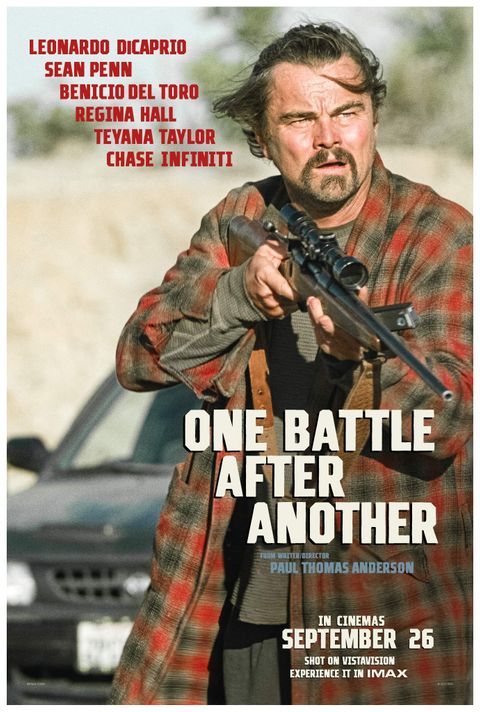

Director: Paul Thomas Anderson
Writer: Paul Thomas Anderson, Thomas Pynchon
Starring: Leonardo DiCaprio, Sean Penn, Benicio Del Toro, Teyana Taylor, Regina Hall, Wood Harris, Chase Infiniti
Year: 2025
Runtime: 161 minutes
Country: US
Search database: